Made in Harlem: A&M–Central Texas Staffer Pays It Forward
By Karen Clos,
Director of Communications —
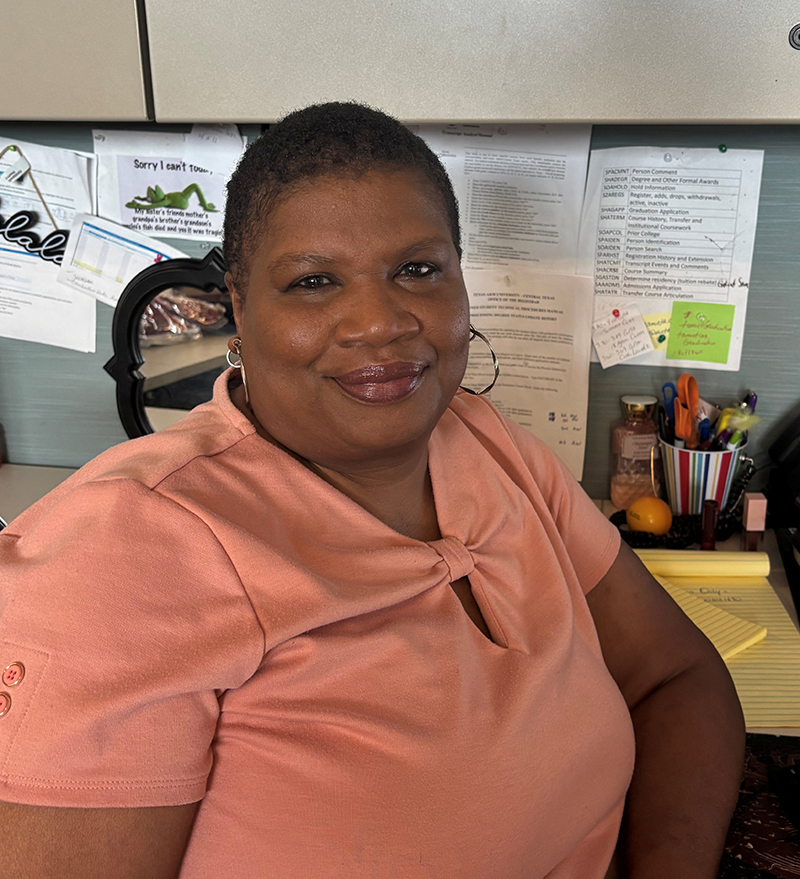
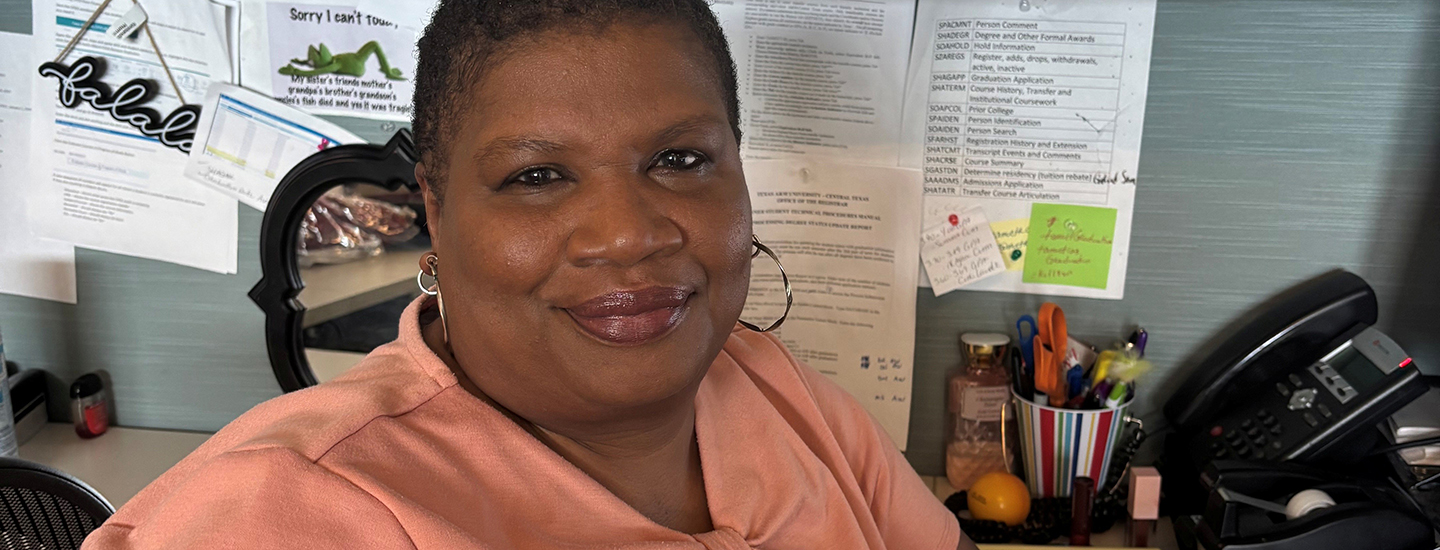
Amelia Terry Smith carries Harlem the way some carry a prayer book—close, steady, and worn from use. Named for her grandmother, Amelia Chisolm, she grew up in the New York neighborhood where brownstones lean into each other like old friends and the sidewalks remember everything. Harlem shaped her before she ever had a say in the matter: its grit, its pulse, its unfiltered truth and its purpose.
And even here in Texas, the traces of that place remain in her cadence, her gaze, and the rooted, unwavering way she stands. One conversation makes it clear: she is a woman built from her place, her people, and her story.
There is, at first glance, a definite ‘hard as nails’ exterior to her: a resolute toughness of a person who has lived – and therefore earned – her fair share of triumph and tragedy and whose gaze invites those who dare to draw near.
There is not one ounce of apology or pretense to this woman, just a firmly grounded, no-nonsense, look someone in the eye and hold it kinda vibe that simply emanates from her. She is built like her daddy, she says, making zero effort to abandon her casual New York City accent that stays with her to this date and has never quite diminished into a drawl – and never will.
At 5’9, both her stance and her deliberate obsidian gaze might give some people a moment’s pause, but they would be wrong to presume that any part of her harbored intimidation. But, she laughs, her family – and only her family – knows that if she is upset and puts her hands on her hips, the argument – whatever it was – is over.
Her colleagues say that those eyes might – occasionally – seem to bore right into the person she’s talking to. And some have noted that she is the master of entirely deflating conflict with a humorous, well-timed comeback. They are, like Amelia herself, quietly covetous of a secret they have come to know about her.
The real her – the side that her students know and embrace – is far more meaningful than height or a seemingly impenetrable stance: it is her heritage, her lived experience, and the quiet, resilient, determined focus that, in Texas, is sometimes playfully described as a ‘git ’er done’ kinda attitude. And, they say, it is contagious.
They know this because they have seen it in action. And they also know that she would never think to brag on it herself, but she would also be the first of many to turn herself inside out in a good-faith effort to help one of her students.
She knows her job, they say. And she does it well. She is the university’s graduation coordinator. Not the ceremonial planner type of graduation coordinator. The kind whose work touches every single would-be graduate, ensuring they are on the right path to degree completion, their coursework fulfills degree requirements upon her review, and their records are free of entanglements or administrative impediments that could stand in their way to the commencement stage.
The average graduating class varies in size. But for the sake of example, assume she has 250 undergraduate and graduate recipients to clear and that there are three commencement ceremonies per year.
That means 750 would-be graduates enter her orbit – every one of them depending on her to fulfill and certify the administrative and legal requirements that undergird the official granting of a degree. And when one graduation cycle is complete, another immediately begins pressing up against the weeks required for grade and degree certification.
Anyone made of more fragile or less determined stuff would have run for the hills after the first year. Maybe two years, if they had even a modicum of her moxy. But Amelia simply refuses to quit on something she believes in. And she believes in these students. And then some.
Her absolute sticktoitiveness isn’t completely her own, she says. It is part heritage, part heirloom—a gift from her mother, Rebecca Chisolm, who raised 10 children – six boys and four girls – in the Drew Hamilton projects off 7th Avenue in New York City.
There, in Harlem, aunts and uncles took part in the civil rights movement, some even arrested on 116th Street during protests. Their Harlem was not the high-gloss version, but a home-grown community shaped by migration and music, brownstone stoops, Sunday morning gospel hymns and jazzy evenings, and the smell of kitchens carried through cement summers and icy winters.
Ask about her educational journey, and she smiles somewhat mysteriously. In her brand of candid reflection, she describes herself as her mother’s third youngest—the headstrong, willful girl who loved school but failed gym every year because she refused to undress for physical education class. Her teenage logic was straightforward: she did not want to get sweaty and mess up her clothes.
This wasn’t laziness. She laughs and calls it stubbornness—the same stubbornness that pushed her to finish PE in night school, get a job in a law office, send herself to college, and push through an unplanned pregnancy in her second year.
She works like she knows the grind because she does. Back then, she says, while working throughout her pregnancy, she would be paid on Friday, buy a box of Pampers and her subway tokens for the week, and set the remainder aside for childcare. After that, she had twenty dollars left.
There is no regret in her telling. Just the same solid toughness of a single mother who had no idea that one constant in her life would eventually follow her to Texas.
By the time her daughter was 13, she was a medical transcriptionist at a hospital where she met and married her first husband, Tyronne. Her hands fold carefully in her lap as she remembers his passing in 2011 and her first position in higher education.
At Central Texas College, she met her supervisor, Elaine Raley—a woman after her own heart, whose persistence matched Amelia’s. Raley nudged and nudged harder until Amelia finally enrolled in the college where they worked.
Amelia treasured her—not just for the encouragement but because she felt genuinely seen. Not like the others, she recalls, who implied her accent was “too much” or that she should “soften up.”
It wasn’t the first time people tried to tell her who she should be. She didn’t need the help, she says. The one who truly saw her wasn’t quitting anytime soon.
It took two prompts from Raley to enroll. She wasn’t being defiant. She had wanted to return to college from the moment she left. But working at a college can stir doubt, too. Smart people everywhere. Titles on doors. Could that be her?
Indeed, it could. By 2009, she had her associate’s degree and transferred to A&M–Central Texas for her bachelor’s. Doubt vanished. Determination kicked into third gear, then fourth. Full-time work. Full-time courses. She made sure no one needed to sense her insecurities.
Just as she neared completion, her husband became terminally ill. She wanted to stop out to care for him; he refused. She remained at his side—as wife and student—with help from her sisters. None of her professors knew. Not even when he passed right before her 2011 graduation.
She went on. Married Bernie Lee Smith. Lost her father, and three months later, her mother—again while she was mid-way through graduate school. Her family set aside their grief to cheer her onward. What she starts, she finishes. Always.
And now the quiet part out loud. Amelia knows her job and she does it well. But she has also mentored three colleagues—Yvonne Clark, Tametha Jeffries, and Melanie Mason—through their degree journeys.
Some, she says, were even more resistant to her urgings than she had been to hers. But the instinct to lift others up was too strong to ignore. She walked with them every step and celebrated with them when they finished.
This instinct, she knows, is either in a person’s bones or it isn’t: the desire to recognize potential in others—students, colleagues, co‑workers—long before they recognize it themselves. To witness the struggle, the progress, the determination, and then the celebration at graduation.
Extraordinary. How one person—and any person—can be filled with such purpose and create such resonating impact. On students. On colleagues. On once‑uncertain co‑workers who now hang framed degrees in their offices. To her, it is simply paying her mentor’s gift forward. It is, she says, the way her mother taught her.