Outdoor Forensics Lab Opens at A&M–Central Texas
by Demetra Paizanis,
Communications Coordinator –
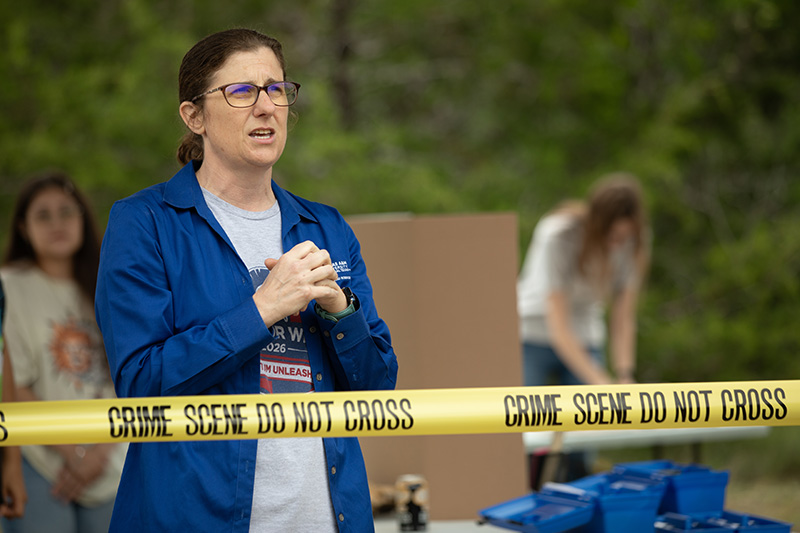
Dr. Tammy Bracewell, associate professor of criminal justice and chair of the social sciences department at Texas A&M University–Central Texas, addresses the gathering at a ribbon cutting for the new outdoor forensics lab.
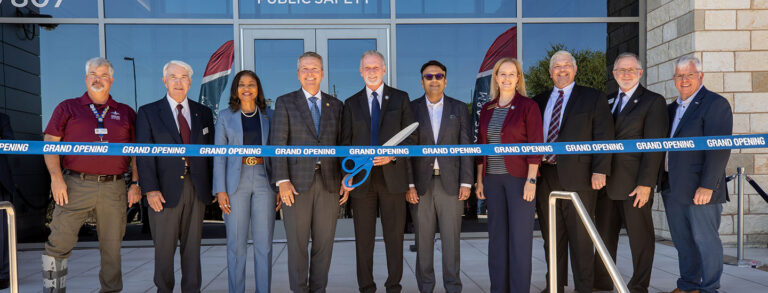
Texas A&M University-Central Texas opened a permanent outdoor forensic training lab on May 8 with a public ribbon cutting, facility tours and forensic demonstrations to showcase how students will process simulated crime scenes and participate in outdoor investigative exercises.
The lab will support hands-on instruction and long-term investigative exercises including mock burials, excavation exercises, evidence recovery and staged crime scene investigations. The site includes open terrain and wooded areas where students will process evidence, map scenes, and conduct mock investigations outdoors.
“Outside, we have the ability to create realistic crime scene scenarios, both on the surface and also buried, that allow for us to connect theory to practice,” said Christine Jones, associate professor of anthropology. “Whether, terrain, and environmental conditions only serve to enhance student’s understanding of how practitioners approach an investigation.”
Before the outdoor lab was established, faculty transported excavation tools, evidence kits and other material to temporary campus locations each semester, often rebuilding exercises from scratch because previously used sites became unavailable. With the forensics lab, scenes can remain in place across multiple class sessions, allowing more complex investigations across extended exercises.
“Students are presented with a crime scene scenario that they work from beginning to end,” said Tammy Bracewell, associate professor of criminal justice and social sciences department chair in the College of Arts and Sciences. “This begins with securing the scene, scene documentation, evidence collection, and evidence processing. Students are required to produce reports and ‘solve’ a crime.”
Students led tours of the lab, explaining how they will process simulated crime scenes in class.
“I’m very excited for this forensic lab to open up,” said Courtney Gibb, a psychology major with minors in forensic science and biological sciences. “It gives us more growth opportunities and allows us to explore different disciplines within forensic science.”
The facility includes a pavilion canopy, concrete work area, outdoor whiteboard, water tank, generator and shipping container storage unit used to house on-site equipment.