History Student Explores Career in Holocaust Museum Archives
By Karen Clos,
Director of Communications –
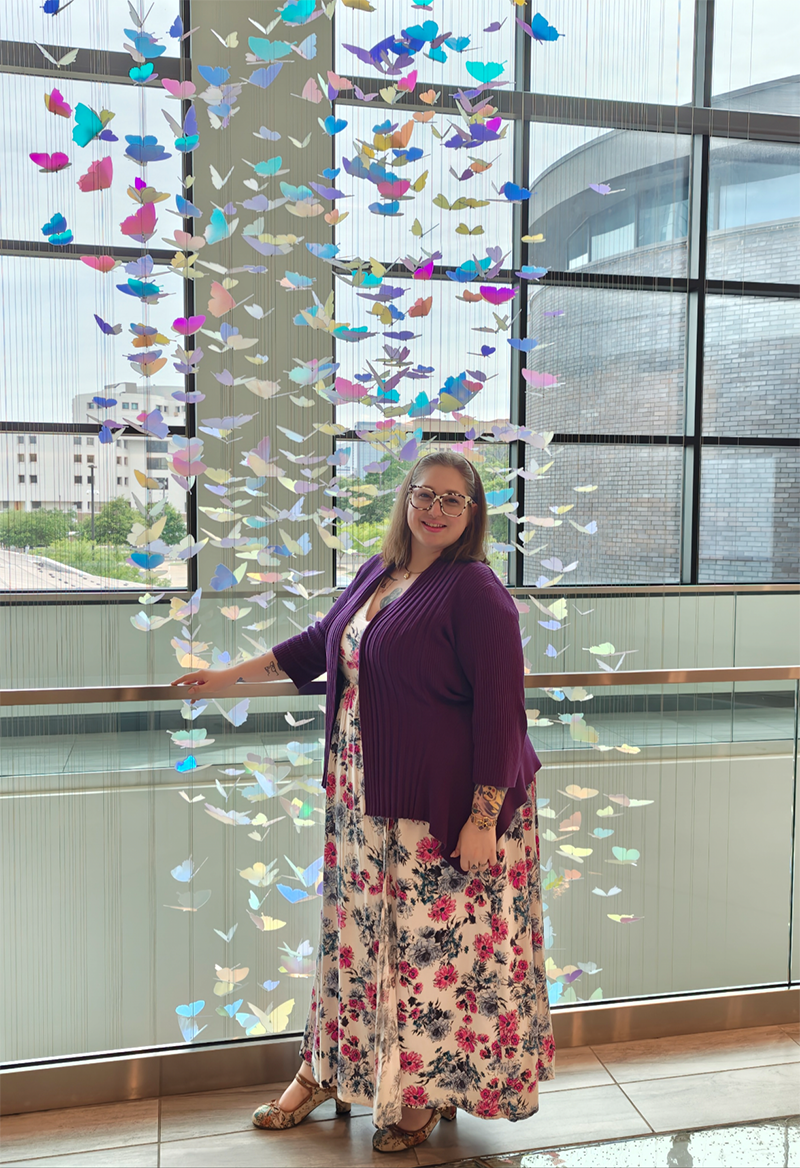
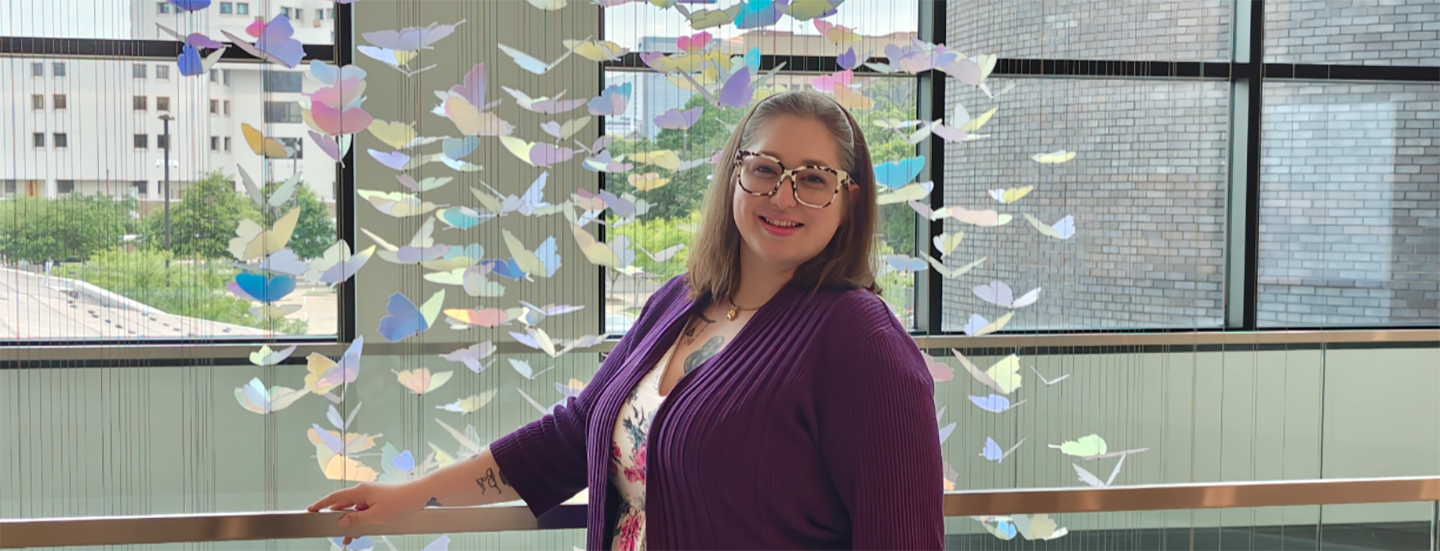
Marihelen Oxford is a history student at A&M–Central Texas. She was recommended by professor Timothy Hemmis for a fellowship at the Houston Holocaust Museum.
When A&M-Central Texas history professor Timothy Hemmis, Ph.D., saw an email from the Houston Holocaust Museum announcing the Warren Fellowship for Future Teachers, he knew exactly the right student to send it to: Liberty Hill resident and undergraduate student Marihelen Oxford.
What he could not have known in that moment is that Marihelen, 31, was questioning the wisdom of being a university student at all.
“I came back to get my degree at 31 years old,” she explained, nudging her oversized lipstick red horn-rimmed glasses a bit higher up on the bridge of her nose.
“I hate to admit it now, because I have made so much progress and grown so much as a student in the history department, but there was a time when I doubted my talent as a student, and that person I was back then would have never imagined one of my professors would encourage me to do something so special.”
Be that as it may – and self-doubt shelved in favor of improvement – Oxford had indeed been working hard to get beyond the belief that she was too old to be a university student. At the suggestion of her professor, she’d been meeting with university writing center tutor, Zachary Whitt, who – like Hemmis – saw promise in her from the beginning.
From his perspective, any student mature enough to reach out to learn those things was going to get the best he had to offer in their sessions.
And there’s no doubt but that Marihelen agrees. Going to the writing center changed more than a few things important to her. Almost immediately, she improved her writing assignments in Hemmis’ class from a C to an A. And in the next year of her studies, she smiles, she would find something even more valuable: her own voice.
All the polish and style rules followed – but her perspective, insights, and depth made her wonder if the same 31-year-old woman who once thought herself “too old” might want to keep going. Maybe to graduate school. Maybe a doctorate.
Turns out, she smiles wryly, that all of these lessons – history included – showed her that being 31 was a good thing. And, she added, the majority of the students she was taking classes with were her own age or older.
“I was meeting with Dr. Hemmis to plan my courses for the next few semesters, and I asked him about the email he had sent me about Warren Fellowship at the Houston Holocaust Museum,” she said, admitting that her first reaction was that this professor she so admired thought highly of her as well. For Hemmis, there was nothing random about it at all.
“Mentoring our students is a very big part of what separates A&M–Central Texas from other universities,” he began. “We’re not saying other faculty don’t take the time to mentor their students toward opportunities that align with their academic goals, because of course, they do.”
But he noted, sometimes it’s the relationships that continue after graduation that allow Hemmis and his other colleagues across campus to appreciate the impact of what they do.
Fox example, Hemmis noted that five former undergraduate history majors recently completed their doctorate in history. For some, their roles now include university teaching and scholarship – meaning that former students and their professor are now colleagues.
In addition, four more doctoral students are completing research and dissertations. Which is why going to the Houston Holocaust Museum meant so much to Marihelen. She wants to be an archivist – without a moment’s hesitation.
And in the brief eight weeks’ time between first learning about the fellowship and actually being there, she is beginning to realize that all of her original doubts about being too aged have faded and something much, much better has taken hold.
She was there, she says – in one of the holocaust memorial exhibits – which included an authentic German railcar used to transport Jews and other victims to concentration and extermination camps.
The one she saw, she says, was refurbished due to age, and some museum visitors, she said, declined to step into it or even touch it.
“It is an imposing thing, to stand there and know all too well what it must have been like for the millions of people who were herded inside, starved, and exterminated,” she said, adding that she had already been to Auschwitz, Buchenwald, and Frankfurt.
What has stayed with her was not the railcar, or the uniforms worn until they nearly disappeared into threadbare cloth. It was meeting Ruth Krell Steinfeld. The kind of story that does not sit still in a display case. The kind that has to be carried forward. The kind Oxford now knows she wants to help preserve. The doubts that once might have tried to define her—too old, too late—have given way to something steadier. Not just certainty. But direction. And without hesitation, she knows where it leads.