Earned It: Police Chief Remembers the Road he Traveled
By Karen Clos,
Director of Communications –
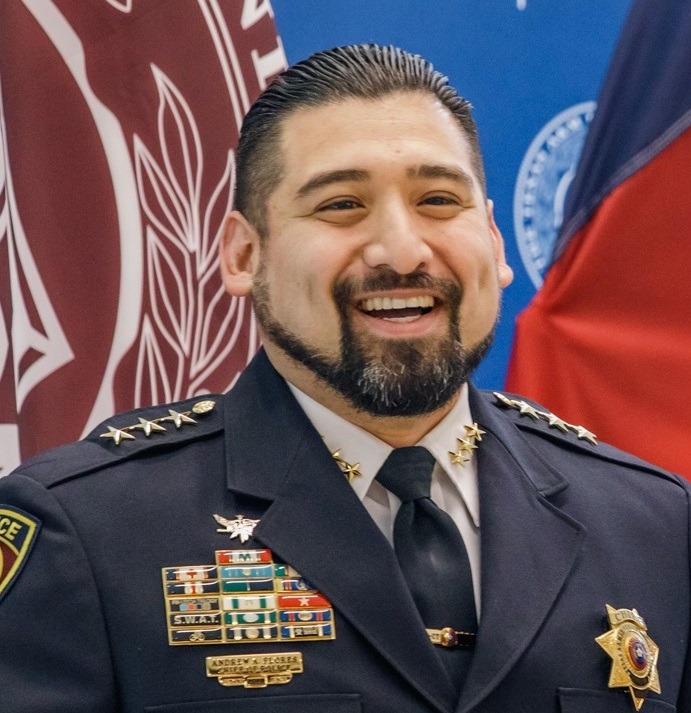
A&M–Central Texas University Police Chief Andrew Flores never chased titles or promotions. Looking back, he’s certain his path comes down to the values his family taught him, the love of a woman smarter than he is, and mentors who saw leadership in him before he ever saw it in himself.
In high school, he was good at all of it: a 3.8 GPA, student government class president, and quarterback. He volunteered. Joined Christian athletes. Ran track. Powerlifted. Boxed. Practiced martial arts.
“I’d been the quarterback for a while, and it was great,” Flores said. “I had a lot of friends. A lot of people looking up to the team. But I wanted to make a switch. I was more into hitting hard than the status of being quarterback, so I switched to defensive end and linebacker.”
Not a mean bone in his body — then or now — just teenage testosterone and the second born urge to define himself on his own terms.
One look at him and things kinda add up. Charm for days. And brains to boot. A genuine people person as comfortable in a black Oakland Raiders jersey at the local taqueria as he is in full uniform behind his desk. Smart. Funny. Deliberate. Broad shouldered and built like a fire hydrant — sturdy, impossible to budge, capable of dropping for 50 burpees simply because he can.
But he’s no giant, he insists, citing his 5’8” stature like it’s a flaw. It isn’t, of course, and he won’t be persuaded otherwise. No pride or pretense in that steady gaze — warm, tiger eye brown eyes and a couple of well-placed dimples that appear the moment he smiles. The kind that might mean he’s thinking about lunch or calculating exactly where he’d strike a bad guy in the throat if he had to.
That balance of charisma and competitiveness may have started on the football field, but it stayed with him — shaping where he went and what he did. And even if Flores never chased opportunity, opportunity certainly seems as if it chased him – albeit, sometimes from a distance.
“I went to Stephen F. Austin University for two years and lived like a traditional college student with rowdy friends who were riding too close to the edge,” he admitted. “I never did anything that would make my mom doubt the boy she raised, but something about it just felt inauthentic, so after two years, I came home.”
Funny how those moments happen. People make thousands of decisions a day without a second thought — until just one that seems of no significance sets the future in motion.
Like when he enrolled at Temple College and faculty member and department chair Lesley Keeling Olson, Ph.D., recognized something in him — something that told her he’d make a damn fine cop.
“I was standing in her doorway asking about how to become a police officer, and she suggested I apply to the academy and offered to endorse me,” he said, still sounding surprised.
He applied and was admitted. But once there, his classmates didn’t see in him what his professor had. No subtlety in their cruelty. He didn’t belong, and they made sure he knew. No matter. He knew exactly what he was made of, even if they didn’t.
By 2011, he had his associate degree in criminal justice, his academy certificate, the highest score on the TCOLE exam, and a first-place ranking in physical training.
Despite an old football spearing incident years earlier that led to an ACL/MCL operation. Yes, he says, he has scars. Badges of honor, really. And it wasn’t the first time someone tried to knock him down. That didn’t matter either. Making excuses or staying down has never been his nature.
He applied to the Temple Police Department two or three times. Took odd jobs for the six or seven months he spent waiting for a call that never came. Again, no complaining. He picked up a dishwasher job. Raised eyebrows don’t bother him. He had stocked bread at H E B at 4 a.m. in high school. Humility, he thinks, feels more authentic than griping.
Stephanie, the girl he met in high school, has been at his side through all of it. She knew exactly what he was made of. She suggested he go back to school for a bachelor’s degree.
“She heard about the university from her family and said, ‘This is where you need to go,’” he said. “It was like an echo chamber. Even my brother was telling me to go.”
By fall, he was in class. He paid tuition by working for a home health agency, caring for a 16-year-old special needs client twice his size.
No one could blame him if he had grown bitter — highest score on the TCOLE exam, highest ranking in physical fitness, and months of waiting. But he didn’t see it that way. He prefers to focus on his time with that client because, he says, it taught him authenticity and service. Lessons he carried into university policing.
“When I look back on the last 14 years, I’m amazed and grateful how everything rolled out,” Flores said. “I was a part-time police officer and graduate in 2012, then became full-time in 2013. Then corporal. Then sergeant. I owe a lot to this university.”
The university owes him just as much. Long before being chief ever crossed his mind, Flores approached his work like he approaches everything else: discipline and devotion.
Just when he might have gotten comfortable where he was, his wife again urged him forward. He listened — with hesitation. No one in his family had gone to graduate school. But once he started, he realized his vision for university law enforcement was justified. In every course. Every conversation.
He wanted the traditional values: officer training, advancement, and service shaped around people while honoring the mission of safety.
Today, he says, A&M–Central Texas officers do more than patrol — they greet students and staff by name on daily walk-throughs. They build relationships on and off campus.
“This Tuesday, one of our new hires, Officer Gallegos, saw a stalled vehicle on Clear Creek,” he offered as an example. “A Killeen officer was helping, and Gallegos saw what the problem was, ran back to campus, grabbed our gas can, and got the guy on the road. That’s exactly what we want to be about.”
Turns out there was still more ahead. After he completed his master’s degree, he thought he was finished with school. He wasn’t. He was in for more nudging.
“The A&M–Central Texas criminal justice faculty have been incredible,” he said, thanking Lynn Greenwood, Ph.D., Michelle Quinones, Ph.D., Tammy Bracewell, Ph.D., and others.
He can scarcely believe it, he says, that he was invited to teach part-time in the undergraduate criminal justice program. And even more surprised that he now teaches at the university where he began.
And the ‘done with school’ part? Think again. Not only did he begin his doctorate, but Flores has also completed his doctoral coursework. First in his family to earn a master’s. And in a year or so, he will be the first to earn a doctorate.
Former Temple High athlete. Temple College alum. Respectful son. Loving husband. Girl dad of three and soon — he grins — a boy. Balancing a full-time career and degrees — not once, not twice, but now four times — hasn’t been easy. But it’s been worth it. Because, unexpectedly, it gave him something he never imagined.
“Sometimes, I’m in the middle of a class, sharing law enforcement experience or talking through a concept with students, he stops, he says, and it’s like—” He pauses as if just the thought of that moment still amazes him. Because if you know this man, you know it does.
“For a moment, my train of thought stops,” he said. “And it is not because I’ve forgotten what I was saying. It’s because it hits me that I’m doing with and for my students exactly what my Temple College professors did for me. And what the A&M–Central Texas faculty did for me and do for so many students.”
He’s not given to emotion, he insists. But he’s clear-eyed as he describes it. This, he thinks, is the love of teaching and learning his colleagues talk about. This. And if this is what the journey was about, he is content. Humbled. Ready. The chance to give back to his students the way his professors gave to him, he says, makes every step and every sacrifice worth it — and then some.