A&M–Central Texas Hosts Student Research Event
By Demetra Paizanis
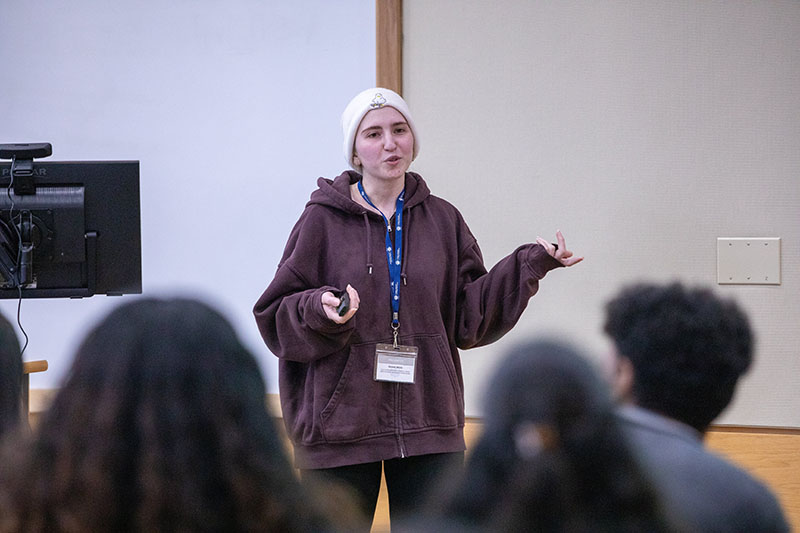
Texas A&M University–Central Texas hosted its third annual Student Research Symposium on Friday, Dec. 5, at Bernie Beck Lecture Hall, where undergraduate and graduate students from multiple disciplines presented original research.
Organized by the Division of Research and Innovation with support from the Psychology Club and the Psi Chi Honor Society, the symposium brought together 15 student presenters whose projects spanned fields including technology, biology, anthropology, psychology, education, and cybersecurity.
Through these projects, students’ course-based learning is the basis for their independent research.
“The symposium gives students real-life research experience, helping them apply their knowledge,” said university president Richard M. Rhodes, Ph.D. “When they stand up and explain their work, they gain the kind of communication experience they may later need in legislative or professional settings.”
Moving from course-based work to independent research introduces students to the expectations and demands of scholarly inquiry.
“Good researchers are not cynics, but they do need to be skeptics,” said Jeffrey Kirk, Ph.D., associate provost and associate vice president for research and innovation. “You look for the holes and the gaps, and you figure out how to fill them. That is how research moves forward.”
Engaging with research in this way teaches students to value the process over outcomes.
“When they present to a public audience, they begin to see how research works in practice and how to identify issues that matter,” said psychology professor Malin Lilley, Ph.D.
As projects are shared and discussed, connections begin to form across topics and disciplines.
“Beyond individual skill development, events like this create opportunities for collaborating by allowing students to identify overlapping interests, exchange ideas, and explore potential partnerships across disciplines,” said Walter Murphy, Ph.D., vice president for the Division of Research and Innovation.
Faculty members serve as advisors for students in navigating unfamiliar material and methods for their projects that range from repairing security vulnerabilities in coding languages to Haitian Vodou.
“It focuses on a small new-world tradition and is very preliminary, but it is valuable experiences for learning ethnographic and cultural analysis,” said anthropology professor Christine Jones, Ph.D., describing a student’s Vodou research.
For students, the faculty support can shape how academic interests take form and direction.
“At first, I felt like a fish out of water because I was nervous and not sure how my major fit into an event like this,” said anthropology student and Haitian Vodou researcher Angelisa Shannon, “but presenting made me feel more confident and grounded in it.”
Organizers hope the symposium serves as an event to place student research in front of the wider audience.
“Attending the symposium meant a lot to me because I take classes online and rarely visit campus,” said student Parker Reed. “Being here in person gave me the chance to see research up close.”
Research presentations included:
- Melissa Davis, “Does Attachment Style Shape Emotional Outcomes in Mindfulness Interventions,” faculty advisor Dr. Kendal Smith
- Robert Evans, “Enrollment and Persistence Predictors for First-Generation College Students,” faculty advisro Dr. Madelynn Shell
- Abigail Faulk, “Is Self-Esteem Related to Stress for TAMUCT Students,” faculty advisor Malin Lilley
- Chyna Fernandez, “Can Focusing on Similarities Combat Negative Out-Group Perceptions? An Examination of Similarity Theory Effects on Racism within Foster Care Recruitment,” faculty advisor Dr. Andria Schwegler
- Maria Figueroa, “Blockchain Third-Party Risk Assessment Framework,” faculty advisor Dr. Deepti Gupta
- Meyah Garnett, “Data Protection Ontology Web Page,” faculty advisor Dr. Lavanya Elluri
- Kara Harris, “In Silico Design of Modular Gene-Silencing Circuits Targeting Transposable-Element-Mediated Antibiotic Resistance,” faculty advisor Dr. Chamindika Siriwardana
- Sereen Idries, “Identification of Microbial Growth in Non-Alcoholic Beer Samples,” faculty advisor Dr. Chamindika Siriwardana
- Likhitha Annapurna Kavuri, “SecureFed: Detecting Malicious Clients in Federated Learning,” faculty advisor Dr. Deepti Gupta
- Akshay Mhatre, “LLM Guard: Detection and Repair of Bugs and Security Vulnerabilities in C++ and Python,” faculty advisor Dr. Deepti Gupta
- Silambarasan Palanisamy, “Semantic NIST Matching and Compliance Framework,” faculty advisor Dr. Lavanya Elluri
- Alexandra Penrose, “Applying Attribution Theory to Academic Success: Identified Assets and Barriers,” faculty advisor Dr. Malin Lilley
- Taylor Petro, “Fear and Conservation Attitudes Toward Large Carnivores Depicted on Social Media,” faculty advisor Dr. Malin Lilley.
- Angelisa Shannon, “Haitian Vodou,” faculty advisor Dr. Christine Jones
- Rifa Tasfia, “Redefining Robustness: Test-Time Evasion Attacks in Network Intrusion Detection Systems,” faculty advisor Dr. Anitha Chennamaneni
- Mitchell Vires, “Attitudes Toward Artificial Intelligence: Age and Acceptance,” faculty advisor Dr. Kendall Smith
The Division of Research and Innovation plans to continue the symposium annually. Students interested in participating in future symposiums are encouraged to identify topics of interest, review faculty research areas, and contact potential faculty mentors to discuss opportunities. For more information, contact Division of Research and Innovation Vice President Walter Murphy at [email protected].