The Long Run
By Karen Clos,
Director of Communications –
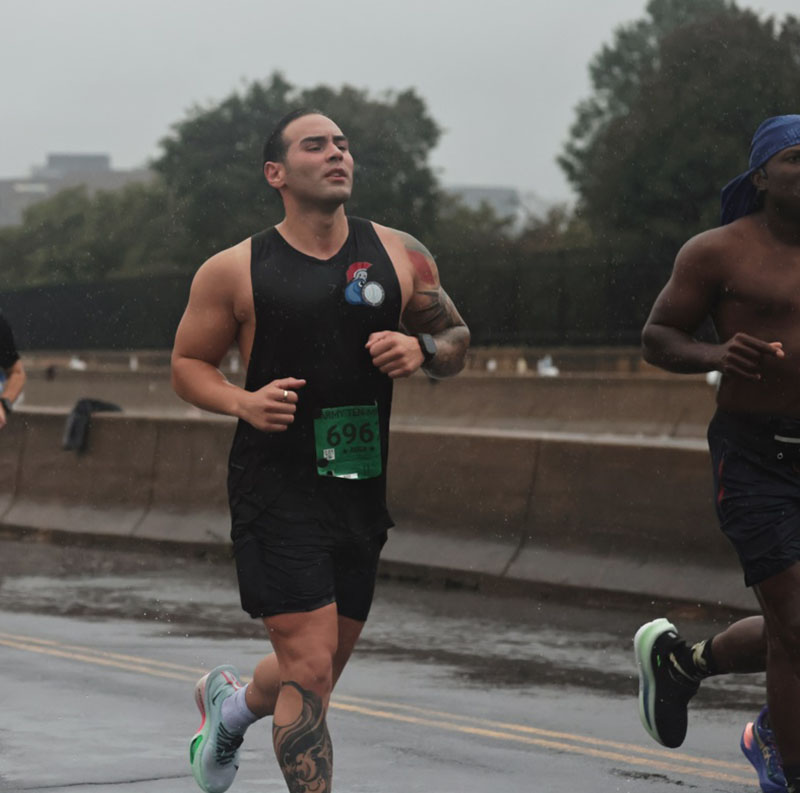
By the time Cadet Danny Perez reached the starting line of the Army Ten-Miler in Washington, D.C., it was raining hard enough that staying dry had ceased to be part of anyone’s plan. Perez and five other runners were there representing two entities near and dear to them: The ROTC company to which they belonged, and a newly formed runner’s club initiated by Perez himself just a few years ago.
At first glance, Perez resembles many, if not all, of the other male cadets in his company. He is muscular and fit, a description that seems almost unnecessary in this context, and at 5 feet, 10 inches, he is neither stocky nor slender. His soldier’s haircut is slightly longer than regulation might suggest; he is, after all, still a student. Strong cheekbones give structure to a face made more distinctive by inquisitive eyes—dark but not brooding. He is observant, alert and fully present, as attentive to the memory while recounting it as he must have been while living it.
He and his fellow cadets had been looking forward to the cooler weather in D.C. – a welcome break from the simmering almost post-summer sizzle that often lingers through October and into November. As he confronted the starting line, he had already been awake for hours, beginning with his own 5 a.m. alarm, set three hours before the race because he knows his body well enough to know what it requires before he asks it to run 10 miles.
There was breakfast, he said, describing the stretching rituals he completed, paying particular attention to ankles he had broken years earlier—one while playing basketball and the other during football practice. His usual race fuel menu sounds less ceremonial than practical: Rice Krispies, protein milk, peanut butter, strawberries and bananas, followed by a carbohydrate powder with caffeine.
By about 6:30 a.m., the six runners had crowded into a Honda CR-V driven by Perez’s brother-in-law, who had come from North Carolina for the race. They rode to a staging area, waited, made another strategic trip to the restroom and, around 7 a.m., headed toward the start. By then, the rain had become as deliberate as they were: pouring in layers that left the city, its inhabitants, and as far as the eye could see, everything awash in a wet cold.
The clothing runners had packed and worn against the morning chill began collecting along the edges of the street as layers were shed before the race. What wasn’t randomly strewn about was hanging over an occasional shrub. One from a low-hanging tree limb. Perez eventually was down to a tank top.
The rain did offer one advantage: It kept them cool. Everything else about it required adjustment.
“Your socks are wet, your tennis are wet, your body is wet, your eyes are wet,” Perez said, adding that the bigger challenge was mental—accepting the discomfort without allowing it to alter the objective. He remembers thinking to himself, “Yes, this is happening, but we’re not going to allow it to stop us.”
For Perez, 29, running has become both remarkably technical and deeply personal. His watch was programmed in alignment with what he knew would be both a best time and, he admitted, hopefully enough to place him competitively among the finishers.
Runners here came from all over the country, so the bar was raised, and he knew it. He was hoping to be near a 7-minute, 45-second pace, and he knew both what he wanted from the race and what he believed his body could do.
At first, he says, the first few miles were complicated as he worked around and among runners moving at different speeds. Once the field began to separate, he explained, he could settle into his race.
With rain in his face, water in his shoes and a soaked phone in his pocket, Perez stopped worrying quite so much about the face of his watch. He could feel it vibrating against his wrist, signaling whether he was above or below the pace he had programmed, so he trusted the training and concentrated on doing something he regularly tells other runners to do: run his own race. His reasoning reflecting a personal observation.
“Comparison is the thief of joy,” he said, repeating one of the lessons he tries to pass along without sounding like a misplaced social media influencer.
It is an interesting philosophy for someone as competitive as Perez, who founded the A&M–Central Texas ROTC Run Club and has watched it grow in the last two years to approximately 40 runners including students, faculty, staff, alumni, and community members. Now, he was in the moment with six fellow cadets who had made the trip, and for five of them, the Army Ten-Miler was both their first competitive race at that distance and their longest competitive race to date.
Perez wasn’t bragging when he casually rattled off the competitions that he had already run. Marathons and half marathons, he said with a shrug. He knew what 10 miles could ask of a body. Some of his teammates were finding out for the first time, and they were also discovering what can happen after someone accomplishes something they had not done before.
Hernandez, Torres, and Perez, he said, rearranging the chronological order of his story: they have, he said, already registered for the Austin Half Marathon, and Hernandez was already talking about something bigger still: a half Ironman.
At the end of the D.C. race, he says, he came to an unexpected conclusion. He enjoyed seeing his teammates complete even more than he enjoyed his personal best time – which he only mentioned contextually as a factual follow up.
“When I crossed the tape,” he said. “They were already there. Korda and Torres. And I was like, ‘Oh, wow. I got some real competition now,’” he recalled. “I need to lock in. But immediately after that, I remembered what I had felt when I finished my first race. And I hoped that moment was like that for them, too.”
It makes sense that bringing others with him acts as connective tissue in Perez’ mind. He is an ROTC cadet – the end goal of which is to become a commissioned officer with an entire career ahead of him.
“Every cadet in our company knows that they will lead enlisted men and women one day,” he said. “But that isn’t the goal; it is the mechanism for fulfilling the promise when we take the oath and swear to defend the constitution, the nation, and the people.”
It isn’t a random realization, and he doesn’t have to say it is. It underlies everything he has done, is doing, and will do. For example, academic records reveal an information technology major carrying 18 credit hours and maintaining a 3.8 GPA.
A student worker for 19½ hours a week where he can often be seen doing practically anything from rolling wrangled pieces of furniture into storage, assisting an events coordinator when needed, and being one of the two students who administratively support the woman who administratively supports the university president.
In ROTC, he serves as the program’s Master Fitness Trainer, developing physical training plans in addition to the regular demands of military science courses, physical training and tactical laboratory requirements. His girlfriend, Daunitia, 31, is also expecting their first child in early December.
That baby girl, whom they have already named Camilia, changes his face one more time from student to cadet to runner to, now, prospective parent as he speaks with the gentle anticipation of a partner, parent, and father.
“Daunitia has already been having contractions and is dilated, so neither one of us think the baby will come when the doctors say it will,” he laughs. “They say December 3rd, but, trust me, that baby has a runner’s genes and she wants out.”
Perez rejects the notion that he – either now or ever – has used the word “over-achiever” to describe himself, even though, he laughs, he takes the good-natured teasing from his friends with surprise.
“Oh, man,” he begins. “The teasing isn’t constant and I don’t mind it. It doesn’t get under my skin because I think they’re genuinely the best friends I could have.” He pauses, describing himself as he thinks of himself: just an ordinary kid with a complicated parental past, who was okay at high school. The 18-year-old who joined the military out of service, sure. But also because he wanted a way out of an old life that – well, no longer fit.
When he was chosen for the Green to Gold program, he was 29. Today, he is a former 25U, a signal support systems specialist, deployed to South America, advising foreign militaries on communications.
If indeed his measured words register hesitation, it is not exactly the right word. It comes from something that neither the transcript nor the résumé would reveal. A disciplined, competitive and steady cadet, content to be both active in the moment and anticipating the future.
And while it may have begun with himself at the center, the circles around him now include the purpose he has committed himself to. Today, it’s the development that matters: who he will become for a partner, a daughter, his friends, and in the service he has chosen. The circumstances will change. He knows this. But the first almost three decades of his life have taught him something. It is all in the becoming.