For the Love of Creepy Crawlies and Students: Professor Recognized with National Award
By Karen Clos,
Director of University Communications and Media Relations –
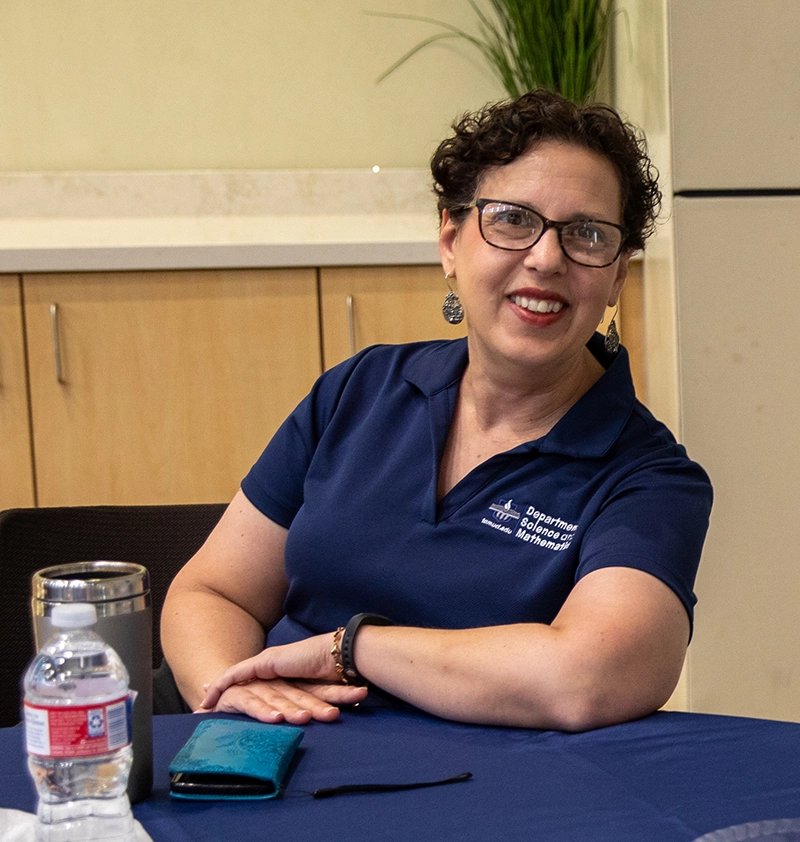
When Associate Professor and Department Chair, Laura Weiser Erlandson, Ph.D., applied for the A&M-Central Texas biology department teaching position in 2014, the university’s first building had been standing for fewer than five years, the second was under construction, and a third was on the horizon.
Back then, she was already an associate professor of biology at a campus that focused on teaching merged within the SUNY Institute of Technology at one of the world’s most advanced university-driven research enterprises in New York. Yet, there she was pressing send in response to the job announcement she had seen and officially offering herself as a candidate for a university only five years old.
During the original interview process, she heard more about that: the university’s history as the then-newest university within the legendary Texas A&M University System.
Over and over, she heard different variations of the same theme. From hiring committee members, the provost, and finally from the inaugural president who made it a point to spend time with each and every new hire.
Because she was already experienced, she knew instinctively what this meant. They were looking for more than impressive credentials and a passion for teaching. They were looking for someone with a bit of fire in their belly. The good kind. The kind that could embrace a challenge, see it through, and keep building because that was the natural trajectory of things.
Of course, the successful candidate would lead the building of the program, its courses and degree plans, and teach the courses and labs. And in addition, they would be the academic leader in biology and chemistry, screen and hire adjuncts, and eventually full-time positions as the program grew, meet with students for advising, and literally build out not one, but three labs and two prep areas within the first five years.
When they weren’t doing that, they’d be expected to serve on department and university committees and, if they intended to be promoted within the professorial ranks, research and publish.
Had she been the kind of person inclined to be intimidated by the ambitious goals that had been shared with her during the hiring process – or even an experienced biology professor looking for a more relaxed or singularly focused position — she might have politely shaken their hands and headed straight for the parking lot.
But she didn’t. The challenge being taken up by this new university and its individual programs did not frighten her. It fascinated her.
In the years that followed, students came to know Weiser Erlandson as a constant presence in their academic lives. She showed up prepared. She challenged them to think critically. She invited undergraduates into graduate-level research projects because she believed they were capable of more than they sometimes imagined for themselves.
That commitment never wavered, even during one of the most difficult periods of her own life. Following a breast cancer diagnosis, she continued teaching throughout treatment and rehabilitation, later becoming an advocate for awareness and support.
Then there are the bugs.
To the uninitiated, they are the small, crawling, flying creatures most people swat away or step around without a second thought. To Weiser Erlandson, they are endlessly fascinating.
As an entomologist, she has spent years studying insects not simply as specimens, but as tiny windows into larger questions about ecosystems, adaptation, and life itself. That enthusiasm has a way of spilling over into the classroom, where students quickly learn that their professor’s appreciation for the natural world extends down to even its smallest inhabitants.
No small love or routine research thread for Weiser Erlandson. She happily lets no chance to go by to allow an unexpected gesture to suggest just how much relevant range one bug might have.
Former student, AHM Zuberi Ashraf, a recent doctoral recipient at The University of Texas, laughed when he remembered attending a biology program social event only to discover that Weiser Erlandson had baked and brought chocolate chip cookies made with love and cricket flour.
Hannah Baratang, who earned her undergraduate degree at A&M–Central Texas before completing a graduate degree in biology at Texas State University, now teaches biology at St. Edward’s University in Austin.
But she was a mere 12 years old when she came to Weiser Erlandson’s biology program as an undergraduate student who had already completed not one, but two, associate’s degrees in biology and chemistry.
That’s right. Barely into an age with double digits and within a year, she remembered, Weiser Erlandson had invited her to work in the lab and encouraged her to engage in actual research with sophisticated equipment usually reserved for graduate students in the larger or more prestigious universities.
Published. Before puberty. As if such things were routine or, for most people, possible.
From there, Baratang completed her undergraduate degree summa cum laude, going to Texas State as a graduate student, running her own biology lab, and eventually teaching. Today, she teaches at St. Edwards University and among the youngest women in Texas and the U.S. teaching in university sciences.
“Dr. E. has always been a great inspiration to me,” she said. “Not every university has faculty members like her. She is knowledgeable, of course. But she is driven to see her students reach beyond what they might see as their limits and show them that they are capable of doing so much more than they thought – even the naturally ambitious or talented ones. I owe her a lot, and I consider myself lucky to have been one of her students.”
For educators like Weiser Erlandson, the greatest reward has always been student success. The awards come later, if they come at all. This past summer, one did. And then, another.
In June, Weiser Erlandson was selected by the Southwest Branch of the Entomological Society of America for its Distinguished Achievement in Teaching. Recognition close to home. Even sweeter, if that were possible.
Oh, it was. It absolutely was.
A total of 29 award recipients were automatically nominated by virtue of the original award at the regional branch level – this time for a single national award. And, once again, Weiser Erlandson was selected again – from a slate of worthy colleagues and scholars for the National Distinguished Achievement Award in Teaching.
More than a decade after arriving as a department of one, Weiser Erlandson accepted the award with characteristic humility, directing attention to her colleagues and the students whose success continues to define the program she helped build.
She is grateful to the colleagues and members of ESA from whom the original branch award originated, but she is as proud of her colleagues, Associate Professor Linh Pham, Ph.D., and Assistant Professor Chamindika Siriwardana, Ph.D., for the continued growth of the program over the past decade.
And, she says, she is grateful that she pressed that send button as an applicant all those years ago, and grateful for the 12 years she has celebrated the university, the science and math programs, and the students and program alumni who are now thriving in their own right.
She chose to apply, she said, because she was drawn to the opportunity of building an entire program, including designing the labs, from scratch.
“I had been a co-creator at SUNYIT, but at A&M-Central Texas, I was able to actually make my vision of what I wanted in an undergraduate biology program real. And I knew,” she concluded. “Once I interviewed and was offered the position, I knew that I had found my home for the rest of my career. My colleagues are very supportive of each other and our students and the university leadership is that way, too. Every time we expand, or a new building is under consideration, the math and science department knows it is ready to take the next bold step.”