Leveraging Lessons to Bring In-Person and Remote Students Together
By Karen Clos,
Director of Communications –
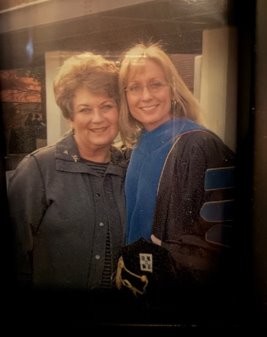
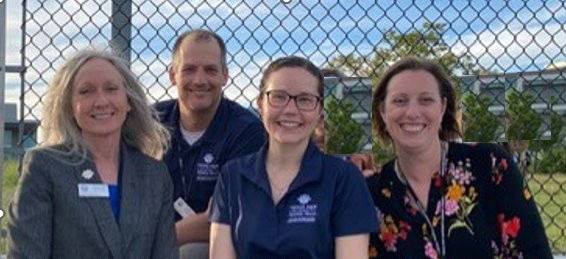
Pictured (left to right) are Dr. Andria Schwegler, Dr. Daniel Clark, Dr. Malin Lilley, and Dr. Madelynn Shell.
KILLEEN – There are no over‑used, empty‑calorie euphemisms describing what Andria Schwegler, 57, and her colleagues in the Counseling and Psychology Department at Texas A&M University–Central Texas have built. The words low‑hanging fruit, paradigm shifts, or other abstract intangibles never once crossed their minds.
It wasn’t jargon that inspired them; it was their students. And they have plenty of evidence of that as undergraduate enrollment continues to grow, and the once‑struggling graduate program has surged from flailing to flourishing in less than three years.
Schwegler would never claim she and her colleagues are more inspired than anyone else on campus. In fact, it’s likely that – until perhaps this moment – they haven’t thought of themselves. But the things they have done to enrich student learning – for on-campus and remote students alike – is very much a part of their own journeys.
Setting the Groundwork for Psychology
For Schwegler, their work is professional, but it is also personal. As a young girl, she watched her mother, Judy Foote—married, raising two children, and working full-time in real estate—take evening classes at a Troy State satellite campus tucked inside a renovated small‑town hotel. In fact, her mother often took her with her.
It was there, she remembers, that her mother’s instructors would comb through their personal collections of books to offer her something to read as they lectured. There, at the tender age of 10, as her mother dutifully took notes in makeshift lecture halls, Schwegler got her first taste of academic exploration quietly turning the pages of borrowed hardcover books.
She was aware that her mother had taken a profoundly brave and undeniably bold step. Maybe even one that may not have been fully understood by those in her social circle.
“All of my mom’s friends married at 18 and had children by 19,” Schwegler said gently, paying homage to the mother who was doing something very definitely outside the norm and chose to take her daughter with her – as if to subtly suggest the choices available to her, too.
By high school, Schwegler thought she might study psychology. Her traditional Southern family advised against it. Psychology, to them, was at best irrelevant and at worst, a concession of helplessness. Out of respect, she deferred. Funny how fate handles things like this, she muses.
Finding Her Way
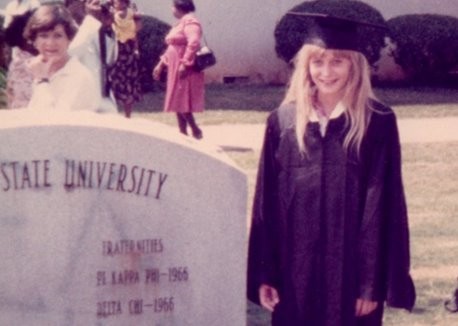
In college, she was facing the same pressures her mother had shouldered. Working 40+ hours on weekends as a waitress, she tutored English during the week, carrying a fulltime course load. A merit scholarship and a small amount of financial aid filled in the economic gaps. One more thing: right before her graduation, she became engaged to a newly minted U.S. Army officer.
It was the beginning of a different kind of challenge: balancing the aspirations of a couple with all the regular pressures that entails – and learning to negotiate the temporary setbacks and challenges of military spouses.
“We married in my last semester so I’d have medical insurance after graduation,” she said. “He was stationed in Oklahoma; I stayed in Alabama to finish school. When I finally joined him, he deployed to Saudi Arabia for Operation Desert Shield. I was 22, alone, and a thousand miles from everything I knew.”
Never Settled
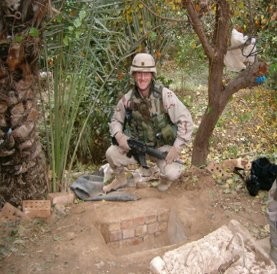
Thirteen moves in 27 years. Dozens of TDYs. Five combat deployments—to Afghanistan and Iraq. Long stretches of living alone in unfamiliar places. A regular life, she might have called it, interlaced with everyday triumphs and setbacks.
She had been searching for a full-time teaching role in the public schools, she explained. A missed phone call in the days before cell phones that might have been that chance.
“I was offered a chance to teach basic psychology at a technical college,” she began. “I had the master’s degree in education that qualified me to do that. I couldn’t have guessed it, but engaging with those students that day was so fulfilling, I knew I had come back to the subject I had once surrendered.”
A second masters – this one in experimental psychology from Georgia Southern – lead to yet another life-changing decision: a doctorate. Once again woven around yet another change of duty station which meant she had to surrender a spot at Auburn and start the application process all over again at the University of Texas at Arlington.
One year in Kansas then Killeen. Another deployment to Iraq. She had remained in Fort Worth, finishing coursework, and preparing to walk the graduation stage to receive her Ph.D.
“My husband, Eric, was deployed to Iraq as part of the support team that captured Saddam Hussein in Ad-Dwar,” she began. “My parents and I were having breakfast at the hotel, and we heard the news on television. My husband might not have been with me, but it is safe to say, it is a date neither of us will ever forget.”
Finding Her Home
Schwegler is at A&M–Central Texas today perhaps at the hand of the same karmic boomerang that returned her to the study of psychology. Twice, she says, in 2005 and 2009, she had earned a coveted tenure‑track position, only to leave.
The first time, she says, was yet another relocation in the days before remote work was even a possibility. The second time, during the birth of her two boys. She wasn’t gone for long, though, she mused. They had already received orders to return to Fort Hood.
“Third time’s the charm,” she laughs. And she’s quick to credit colleagues Jeff Kirk, Coady Lapierre, and Sam Fiala for welcoming her back.
Connecting with Students
“I literally lived the life that so many of our own students are trying to navigate,” she added. “The university had really built out the technological infrastructure that gave us all room to enrich both the online and in-person degree programs.”
In an academic environment that doesn’t just ladle out euphemisms for progress, but encourages creativity and transformation, Schwegler and her colleagues united around a common belief: the traditional way of separating online and in-person learners just wasn’t working. So, they set out to reform, focused on the obstacles.
To their way of thinking, there was a gap. The traditional, face-to-face, enriched lecture and exchange experience and remote options with just as much heft but less interaction. Now, Schwegler says, both formats are being thoroughly integrated, and the students are voting with their feet as the programs continue to grow.
“There was no real reason not to integrate the formats,” she explained. “Now our remote students and on-campus students interact in real time whether they are in person or at a distance. And everyone is thriving.”
Even the departments clubs and community service groups are blended. One large, renovated classroom big enough to accommodate those attending in person with those at a distance. Funny, Schwegler muses, how often some institutions plan around limitations rather than exploring the creative options built to inspire engagement as evidenced by a slogan recently thought up by the students themselves which proclaims, “Psychology Club nerdy? I Think Neuron to Something.”