On an Orchard in Mississippi, a Pilot Keeps Her Eyes on the Sky
By Demetra Paizanis
On quiet mornings in Merigold, Miss., sunlight filters slowly through the pecan branches outside Rebecca Parker’s home office window, catching on the long rows of orchard trees that stretch across her family’s four acres. Dew settles on the grass in silvery beads, birds rustle in the branches, and the world takes its time.
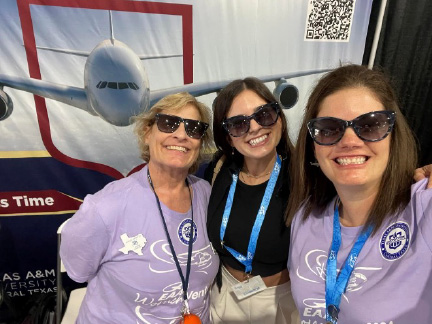
Rebecca Nicole Parker, right, and Dr. Angie Griffin, left, pose with a graduate from the A&M–Central Texas aviation program during a recruiting event in the summer of 2024 in Oshkosh, Wis.
Then an abrupt sound arrives at the edge of a moment, a faint humming grows steadily, threading through the stillness until it becomes something she cannot ignore. A deep and dark rumble contrasts with the softness around her, rising above the warmth of sunlight and above the muted sounds of the orchard. Without a second thought, her eyes lift.
“I can’t not look at an airplane flying over me.”
Long before she taught students at a university, long before degrees lined her walls, or her family planted orchards on land she now calls home, she grew up on the Mississippi Gulf Coast, a place where the horizon felt as wide as the imagination it inspired. Salt hung in the air. Seagulls glided along the wind. Breezes carried warmth from the water, and on many days, aircraft from nearby Keesler Air Force Base swept overhead in confident arcs. While some children chased kites along the shoreline, she chased the paths airplanes carved into the sky.
Her father, who served in the U.S. military and later worked as a civilian contractor, often traveled around the world. Each time he returned, he brought pieces of other places home to her. A Japanese kimono with delicate folds she could trace with her fingertips. A Russian matryoshka doll set she could open again and again, almost endlessly. Jewelry with stones from countries she had only ever seen on maps. Though she had not traveled yet, each gift served as a reminder that the world stretched far beyond her immediate neighborhood and hinted at a life that might someday take her farther.
Rebecca Nicole Parker takes a selfie in front of a King Air airplane that she used to fly.

In high school, Parker climbed into the back of a C130 during her time in JROTC. Inside its metal frame, the engine’s vibration moved upward through the floor and into her body, humming in her ribs and settling in her chest. Her desire to fly settled into her very bones. Not long after, she had her discovery flight. A female pilot flew her over Deer Island and over her childhood home, places she had memorized form the ground but never seen from above.
“It is one of my fondest memories that I flew a plane before driving a car.”
When the wheels left the earth, she felt the surge of energy she had once associated only with stories of pioneers.
“I was soaring like Harriet Quimby, Amelia Earhart, Jacqueline Cochran, and all the other aviators who came before me.”
To keep soaring upward, she would eventually need discipline and education alongside her immense passion. Between 2009 and 2012, she worked at the Bolivar County Public Library while completing her degree in commercial aviation at Delta State University, shelving books during the day and studying the science of flight whenever she could. After graduation, she stepped into the roles she had once admired from afar.
At Flight Training of Mobile and Lightning Aviation, she taught Navy and Marine officers, guiding them through their first hours in the cockpit and foundational flight training. Later, she moved into Part 135 charter flying with Jet Services, where she prepared aircraft for missions, programmed flight management systems, and flew air ambulance routes that demanded steady focus and precision.
As she worked, she continued to learn, earning a Master of Science in Aeronautical Science from Embry-Riddle with a specialization in Aerospace Aviation Management and later completing an Educational Specialist degree in Higher Education at Delta State. After completing her master’s degree, Parker began teaching in higher education, supervising testing centers, refining aviation curricula and guiding students through coursework and flight labs, cultivating confidence and ambition in the next generation of pilots.
“I love flying airplanes, and I love teaching,” she said. “Is there anything better? Not in my book.”
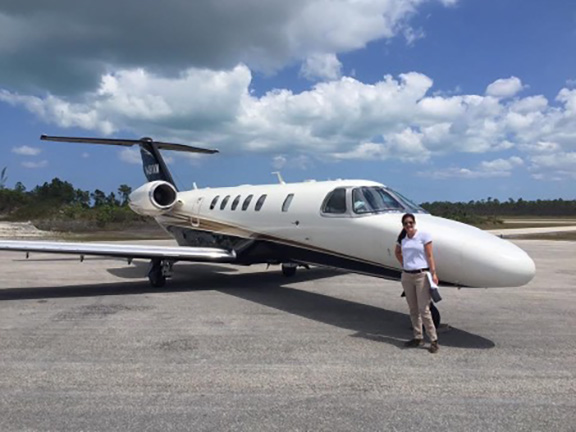
Rebecca Nicole Paker poses in front of a CJ4 jet. Parker is an assistant lecturer in the aviation program at Texas A&M University–Central Texas.
Once again, life expanded once she became a mother. With two daughters watching her closely, she realized how quickly children absorb the world around them. Listening with intent and mimicking with their heart, children look for themselves in the stories they hear. Knowing that, Parker pushed her work beyond the cockpit and classroom, founding a local Women in Aviation International chapter. She organized aerospace events for young people and set out to broaden the image of who aviation is for and what a pilot can look like.
“I hope to instill that the love of aviation is for everyone.”
Eventually, her path carried her to Texas A&M University-Central Texas, where she joined the Aviation Science program as an Assistant Lecturer in 2024. Working with students whose own dreams are beginning to lift, she teaches them the mechanics of flight and the responsibilities that come with it, encouraging them to see themselves as stewards of safety, professionalism, and curiosity.
Flight is the act of choosing direction, and for Rebecca Parker, that direction has nearly always moved upward. Nonetheless, she remains grounded in the understanding that ascent is powered by more than ambition. When the morning settles around her, when sunlight reaches through the pecan branches and planes arc overhead, she knows the foundation beneath her is steady. “I have two healthy daughters, a wonderful husband, a supportive church family, and the best job ever. I could not ask for more. God and my family are the most precious parts of my life.”